Clockwork Vs. Ezekia: Which Executive Search Platform Is Right For Your Firm?
For executive search firms, choosing the right platform isn’t just about features—it’s about how well the system supports your search process, from initial research through to placement and client reporting.
Choosing between Clockwork and Ezekia comes down to how your firm prefers to operate.
Both platforms are used by executive search firms, but they take fundamentally different approaches to managing searches, workflows, and data.
Clockwork is built around a structured, workflow-driven model designed specifically for supporting and configuring a retained executive search process. Ezekia is a customizable executive search platform, allowing firms to control access and build the system around their internal processes.
This page breaks down the key differences to help you determine which approach aligns best with your firm.
Key Differences at a Glance
- Platform-guided consistency vs configuration-dependent consistency
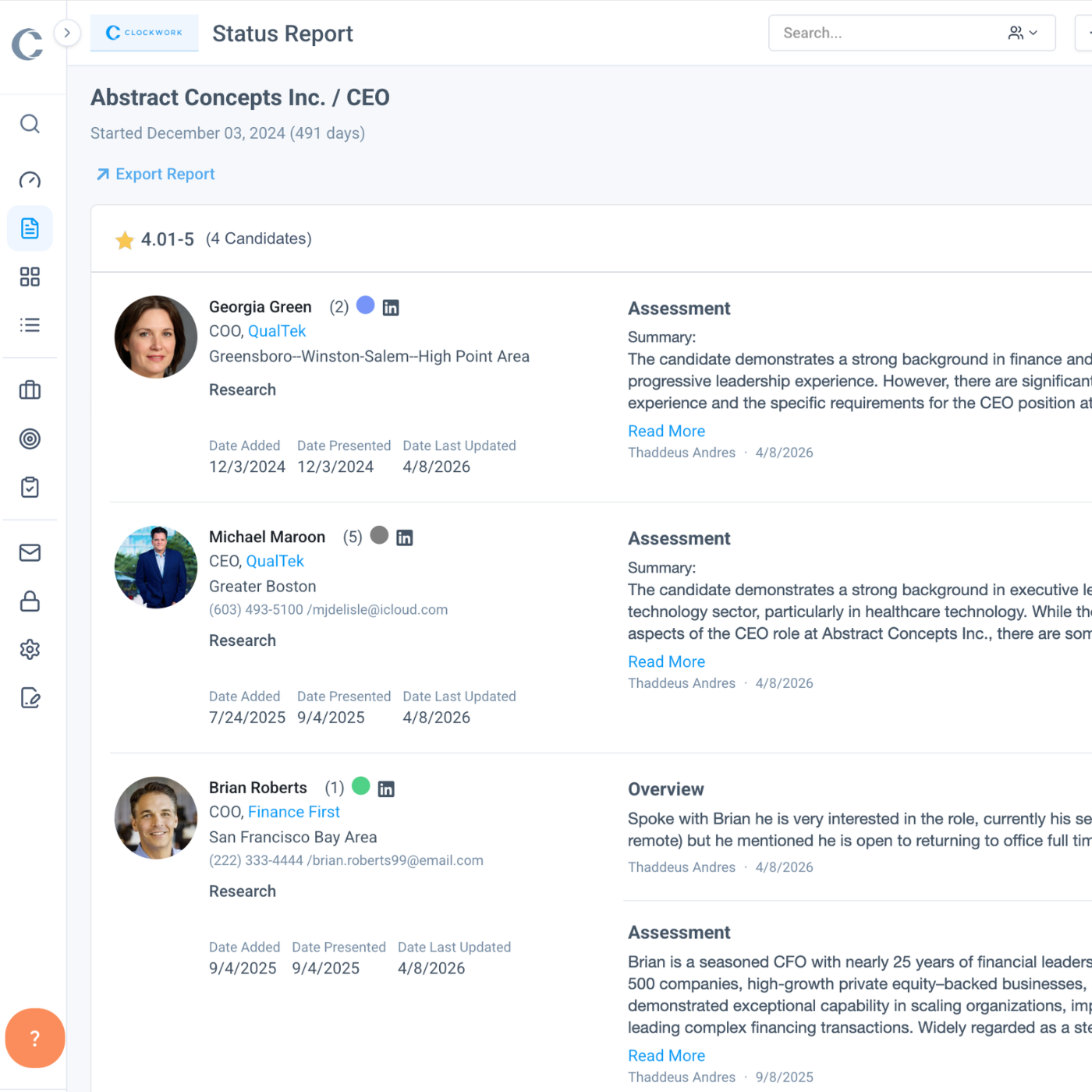
Clockwork drives consistency across teams through structured workflows, while in Ezekia, consistency and delivery depends on how the system is configured, governed, and adopted internally. - Pre-configured out of the box workflows vs user-defined workflows
Clockwork guides teams through a consistent search process with pre-built stages, statuses and workflows, while Ezekia allows firms to design and manage their own pipelines, stages, and processes.
-
Client collaboration platform and real-time reporting vs customizable reporting outputs
Clockwork generates reporting directly from live search data and enables real-time client collaboration through a dedicated client portal workspace, while Ezekia offers flexible reporting that can be tailored to firm preferences but depends on configuration and setup. -
AI embedded within workflows vs configurable automation
Clockwork embeds AI directly within the search process from sourcing to candidate evaluation, and pipeline workflows. Ezekia relies more on user-configured integrations and automation, with AI capabilities varying based on third-party tools, add-ons and integrations.

- Best for: Retained executive search firms (1–50 consultants) running structured, multi-stakeholder searches
- Strengths: Workflow-driven execution, AI embedded directly within the CRM platform and search process, integrated client collaboration and reporting, real-time visibility across searches and BD.
- Considerations: Designed specifically for retained search with flexible configurations instead of requiring in-depth customization and process building.
-
Best for: Firms that prioritize flexibility, in-depth customization, and access control over how their workflows and data are structured
-
Strengths: Highly customizable platform, flexible data structures, customizable reporting.
-
Considerations: Requires setup, governance, and ongoing management to maintain consistency across teams and searches
How to Evaluate Executive Search Platforms
Before comparing platforms in detail, it’s important to understand what actually drives performance for a retained search firm. Most executive search firms should evaluate platforms based on:
How closely the system aligns with your search process and workflows
High-level visibility across searches, teams and activity
Consistency in client reporting and experience
Ability to leverage firm intelligence and past searches
Onboarding and Time-to-value
Time-to-Value vs Time-to-Configuration
Clockwork is designed to deliver value quickly by providing a structured starting point based on how retained executive search firms already operate. Workflows, pipelines, reporting structures, and collaboration are pre-built to organically support the search process and are highly configurable. Rather than requiring teams to define how work should be structured and customize the software, Clockwork's process-led platform reduces onboarding time, accelerates search lifecycles and helps firms standardize execution.
Ezekia takes a different approach by prioritizing flexibility from the outset. The platform allows firms to configure workflows, fields, pipelines, and reporting structures. Because of this, time-to-value is closely very tied to how the system is implemented. Firms typically need to build and define their workflows, configure data structures, and align reporting outputs before the platform fully reflects how they operate. This approach can be powerful, but it introduces a dependency on set-up, internal ownership, and ongoing optimization.
Client Reporting & Collaboration
Clockwork generates client reports directly from active search data, ensuring that updates reflect real-time progress without requiring manual formatting or exports. Reports are pushed to the client portal, capturing progress and reflecting the key milestones of a search. This enables clients to review candidates, provide structured feedback, and remain aligned at every stage. By embedding collaboration directly into the client platform, Clockwork reduces back-and-forth communication, reduces time spent on reports and centralizes all feedback within the context of the search.
Ezekia provides flexible reporting capabilities, allowing firms to design reports that match their preferred format and style. Data and reports can be exported based on how the system is initially configured. Although this approach offers control over how reports are presented, it typically requires firms to define reporting structures upon set-up to ensure that underlying data is consistent. Ezekia's client portal has limited engagement and collaboration features - so firms rely more on external tools and methods for capturing and managing client input and feedback. This can require firms to work across multiple platforms or shared docs.
Candidate, Data & Pipeline Management
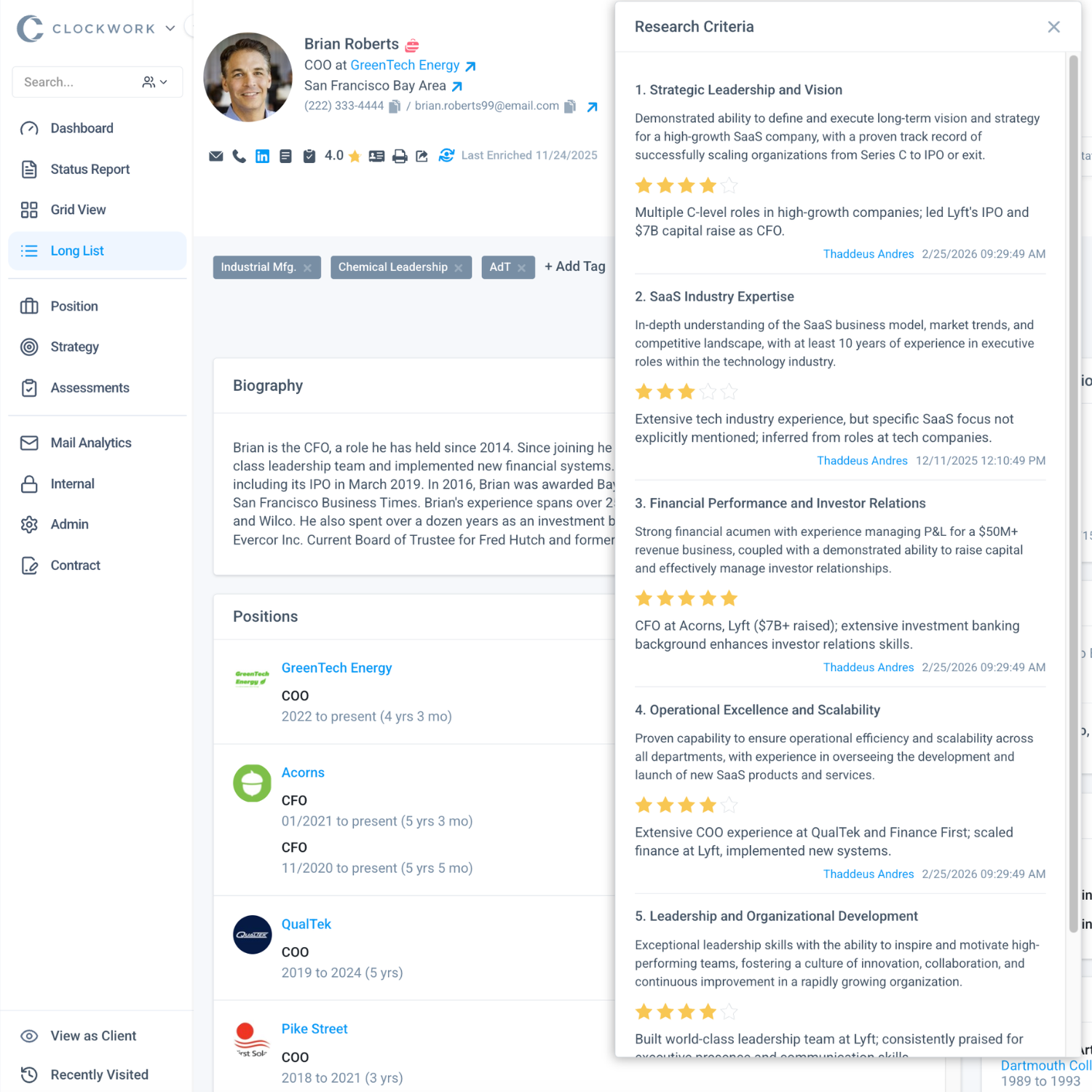
Clockwork structures candidate data within the context of active searches and pipelines. Longlists, shortlists, and candidate progression are all tied directly to the project and pipelines dynamically reflect real-time activity across the firm. This makes it easier to track engagement, status updates, and visualize mobility across multiple searches. Clockwork also supports candidate sourcing, rediscovery and assessment, with AI. AI leverages firm intelligence, past search performance, candidate engagement and more to match, source, rate and assess candidates. The result is a more contextual and search-driven view of candidate data, accelerated by AI.
Ezekia provides a highly customizable approach to candidate and pipeline management, allowing firms to define how candidates are organized, categorized, and tracked. This flexibility supports a wide range of use cases, which leaves adoption and execution open-ended depending on the user. However, the effectiveness of pipelines and candidate management depends upon a strong system implementation, consistent knowledge management practices and team compliance. Firms can tailor pipelines to their needs, but must ensure alignment across teams to maintain visibility, consistency and value.
Process Standardization vs Process Ownership
Clockwork standardizes how searches are executed by aligning with the retained search process, where workflows are organically built directly into the platform. This guided process helps ensure that all users and teams operate within a consistent framework, making it easier to track progress, manage searches, and maintain quality. This is especially helpful for scaling teams or running multiple searches, as new team members can easily adopt and execute an established process. Standardized workflows enable searches to close faster and improve placement rates, where Clockwork's process-led platform serves as your internal champion.
Ezekia emphasizes process ownership by allowing firms to define how their workflows are set-up and executed. This level of access control enables firms to closely replicate their internal processes within the system. Since workflows are user-defined, consistency and performance depend on how well the system is governed, maintained and team members are trained. Without clear internal standards or guidance - consultants may structure and manage searches differently, which can impact visibility, data hygiene, reporting consistency, and scalability.
A.I. and Automation
Clockwork's platform embeds AI features directly into the platform and search process, applying it at key stages such as sourcing, candidate rediscovery, assessment, and more. Rather than operating as a separate tool, AI is integrated into day-to-day activities, learning from teams and stage specific milestones. This enables teams to launch a search and generate a qualified and rated longlist in less than 10 minutes - all against search-specific criteria and benchmarks. This reduces time spent on research, screening and data management. Clockwork directly aligns and builds AI into the search process, accelerating search delivery without requiring users to switch platforms, build integrations or learn new tools.
Ezekia supports automation and AI through customizable triggers, and integrations, allowing firms to streamline certain tasks across platforms. AI capabilities are less central to the platform’s core positioning and are typically dependent on third-party integrations that are custom-built. As a result, AI-enablement in Ezekia requires firms to define outcomes and expectations and build within the limitations of APIs. This limits how firms can drive for value with AI effectively, and possibly creates a wider gap between firm intelligence, candidate data and search delivery.
Business Development & Lead Generation
Clockwork's business development CRM leverages configurable deals, BD pipelines, stages, and projects. Managed directly alongside active searches, teams can track target accounts, active opportunities, and client engagement. This creates a continuous flow of BD from initial outreach and relationship building through to search conversion and execution. Firms can identify leads and opportunities through relationships, manage outreach and report / forecast pipeline revenue. This helps teams balance and visualize both BD activity and live searches alongside one another, generating clarity and consistent work.
Ezekia provides BD tools that support business development through its customizable database, allowing firms to track prospects and relationships. Firms can manage companies and contacts where pipelines can be configured to track opportunities, leads, or client engagements. Because business development and search workflows are customizable rather than inherently linked to broader team activity, BD and search activity operate in different silos, requiring either additional setup, process alignment or proactive oversight.
When Clockwork or Ezekia Is The Better Fit
- Executive search firms focusing on standardizing and optimizing their execution of retained searches, helping firms operate with consistency, visibility and efficiency
- Executive search firms that prioritize process over customizations, looking for a configurable, out-of-the box platform with a quick ramp-up and onboarding.
- Firms that need a client collaboration portal that ensures transparency and delivers a high-touch client experience
- Reducing manual efforts, coordination, onboarding, and reporting
- Generalist search firms that require customization and control over process-based workflows
- Access and customization around how pipelines, teams and data are structured
- Replicating existing internal processes in a system with in-depth set-up and maintenance over time.
- Firms that have knowledge management or training teams in place to ensure consistency and adoption.

Most firms evaluating platforms look at multiple options and want to understand how each fits their process
Continue Your Evaluation
Explore Ezekia Alternatives
See how Clockwork compares to other executive search platforms.

Best Executive Search Platforms of 2026
Read our deep dive of the top platforms and software made for executive search.

How To Choose Executive Search Software
A step-by-step guide to evaluating platforms, key criteria, and common pitfalls.



- How closely the platform aligns with your executive search process
- The level of flexibility required as the firm grows and your process scales
- How much time you are currently spending on manual research and reports
- The importance of AI in optimizing and accelerating the search process

Still Comparing Options?
See Clockwork In Action
Choosing the right executive search platform ultimately comes down to how well it supports your firm’s workflow, your team, and your clients.
If you’re evaluating Clockwork alongside Ezekia, the best way to understand the difference is to see how these workflows compare in a real search scenario.

