Clockwork Vs. ThriveTRM: Which Executive Search Platform Is Right For Your Firm?
Choosing Between Execution-Focused Search and Relationship-Driven Talent Networks
Executive search firms evaluating Clockwork and Thrive TRM are often comparing two fundamentally different approaches to running a search firm. This comparison is not just about features—it’s about how your firm executes searches, makes decisions, and delivers results to clients.
Do you need a platform that structures and accelerates live search execution?
Or a platform that prioritizes building and activating long-term talent networks?
Key Differences at a Glance
- Execution-focused platform vs relationship intelligence platform
Clockwork is designed to run retained searches end-to-end, while Thrive TRM is built to manage and activate talent networks. - Search-driven context vs network-driven visibility
Clockwork organizes work around active searches and pipelines, while Thrive TRM centers around relationships, connections, and talent pools. - Faster decision-making vs broader relationship insight
Clockwork helps teams evaluate, benchmark, and move candidates forward quickly, while Thrive TRM provides deeper visibility into long-term engagement and connections. - Outcome-driven workflows vs engagement-driven workflow
Clockwork structures work around milestones and deliverables, while Thrive TRM emphasizes ongoing interaction and relationship management.

Best for: Retained executive search firms (1–50 consultants) running structured, multi-stakeholder searches
Strengths:
-
Purpose-built CRM for retained search configurable to project, search and candidate needs
-
Robust candidate engagement, and relationship tracking and search project management tools that deliver deeper insights and context
-
Client collaboration portal
-
AI features and tools embedded directly in the platform to accelerate sourcing, evaluation, longlists, scoring, and more.
Best for: Firms prioritizing relationship intelligence, talent pooling, and long-term network development.
Strengths:
- CRM capabilities and relationship intelligence mapping.
- Talent pooling and candidate engagement tracking
- Focuses on pipeline and talent-driven workflows versus search outcomes and placements
How to Evaluate Executive Search Platforms
Before comparing platforms in detail, it’s important to understand what actually drives performance for a retained search firm. Most executive search firms should evaluate platforms based on:
How closely the platform and features align with your needs.
Does the platform support every stage and step of the search process?
How is business development structured?
Context-Driven Assessments For Deeper Client Collaboration
Talent and Search Intelligence
Search-Specific Evaluation & Context Depth
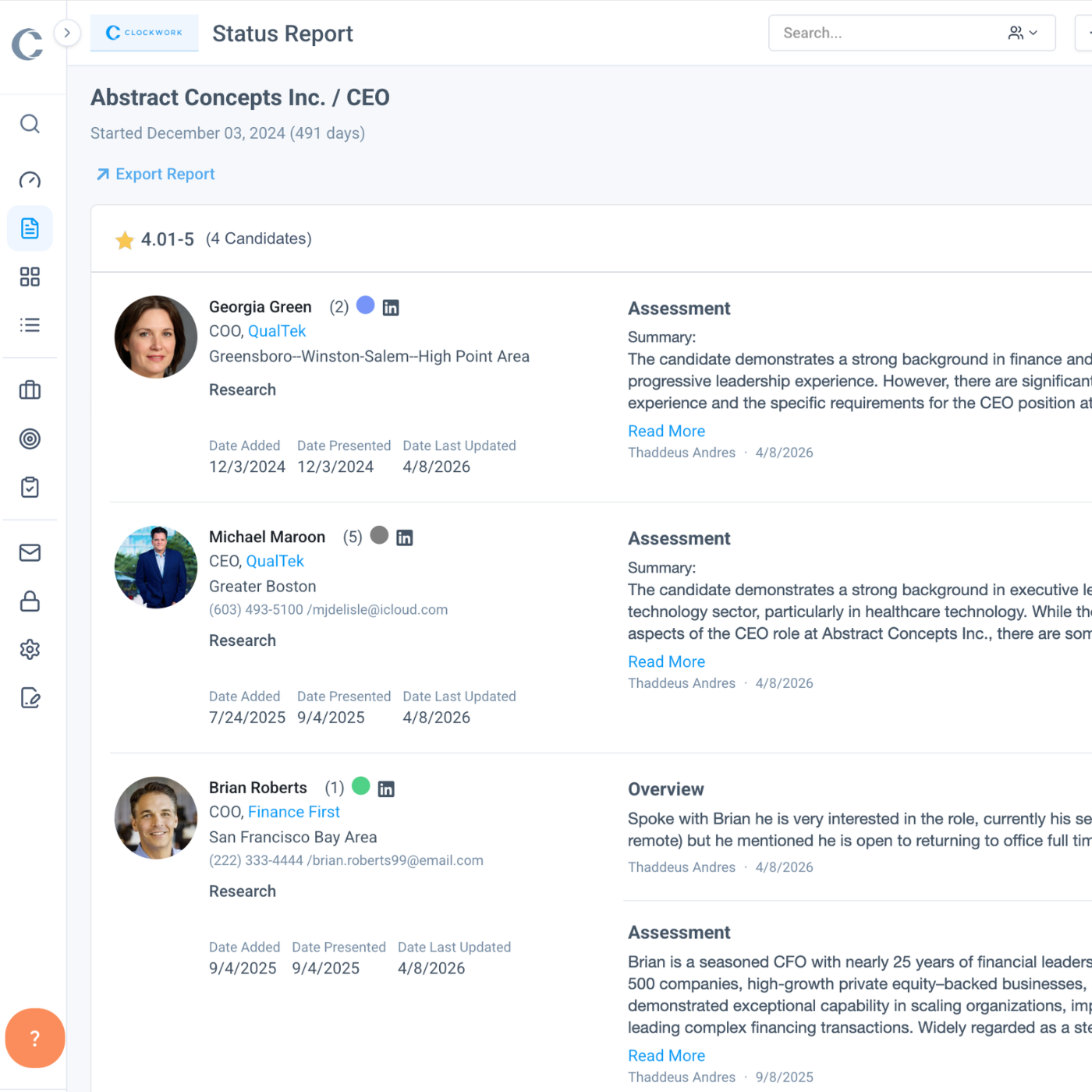
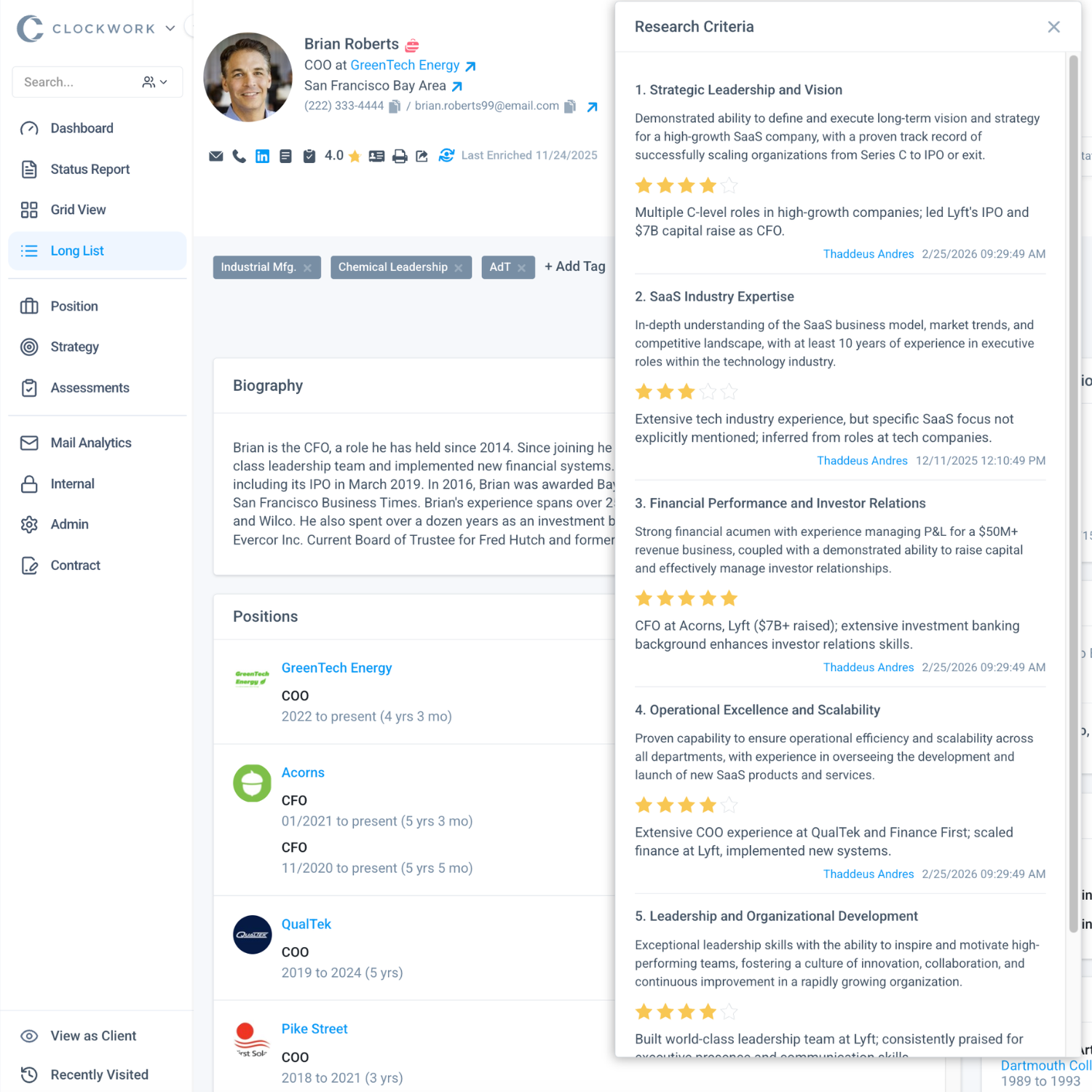
Clockwork is built to accelerate decision-making during live searches, where every candidate is evaluated against defined criteria, benchmarked, and progressed through clearly structured stages. Scorecards, ratings, rankings, and research criteria are embedded directly into the workflow, allowing teams to quickly compare candidates, align internally, and present confident shortlists to clients. Because all stakeholders are working from the same structured context, decisions are faster, more consistent, and tied directly to search objectives.
Thrive TRM supports decision-making through relationship insights and historical engagement data, giving recruiters a broader view of candidates across the network. Teams can assess interactions, connections, and prior touch points when considering candidates for a role. However, structured, search-specific evaluation and benchmarking are less prescriptive, meaning alignment and comparison often depend on how teams define and apply their own evaluation frameworks within the platform.
Market Intelligence vs Network Intelligence
Clockwork captures intelligence across both search execution and relationship mapping, allowing firms to track, manage, and visualize how candidates, clients, searches and markets connect. Relationship mapping, notes, and engagement history are enriched through active searches, while search projects and pipelines can be configured to support proactive research. This means firms are not only building a network—but continuously validating and refining it through real search outcomes, creating a compounding layer of actionable intelligence tied to performance.
Thrive TRM excels in network intelligence and relationship mapping, enabling firms to visualize connections across talent pools, track long-term engagement, and build a deep understanding of their ecosystem. Its strength lies in helping firms maintain and activate their network over time. However, because this intelligence is less tightly anchored to structured search execution and candidate performance, translating insights into consistent, scalable workflows depends on whether teams follow a consistent process within the platform.
AI for Search Acceleration vs AI for Network Activation
Clockwork applies AI features and processes directly within the workflows and core stages of the search, including sourcing, rediscovery, candidate evaluation, position detail generation, profile summarization and more. AI is not just used to find more candidates—it is used to surface, qualify and align talent against defined search criteria. This ensures that AI contributes to better decisions, faster research timelines, and higher placement quality, rather than simply increasing volume.
Thrive TRM leverages AI to enhance network insights, talent discovery, and engagement workflows, helping recruiters identify connections, surface relevant candidates, and activate their networks more effectively. AI supports relationship-driven strategies by improving visibility into talent pools and interactions. However, its application and use of AI is more focused on enhancing network intelligence rather than deeply embedding AI into search evaluation, talent assessments and search delivery.
Platform Configuration And Search Process Alignment
Clockwork offers configuration across three critical layers of an executive search: process, projects and people. Firms can define search workflows, tailor project and candidate data, configure project types and requirements, statuses, customize candidate profiles, build pipelines, define in-depth client reporting and more. This allows firms to adapt the platform to their methodology while maintaining a standardized, scalable operating model. The result is controlled flexibility, where customization enhances search execution and delivery rather than fragmenting it.
Thrive TRM provides strong configurability at the data and workflow level, allowing firms to customize fields, pipelines, and relationship structures to reflect how they manage talent and interactions. This flexibility is particularly powerful for shaping how networks and engagement are tracked. However, because configuration is less anchored to a defined search execution model, consistency across teams and searches depends more heavily on internal governance, training, and process alignment rather than the platform itself guiding that structure and informing those flows.
Complete Business Development vs Lead Tracking
Clockwork embeds its business development and CRM directly into the platform, allowing firms to manage deals, track opportunities and revenue pipelines. Firms can build BD pipelines and BD projects for lead generation, lead management and outreach, directly alongside active searches. This gives teams full insight and visibility into both revenue generation, active pitches and search delivery. By centralizing BD and search project management - this creates a continuous flow of opportunities and new searches, where firms take a targeted approach to winning more referral searches and generate more work that fits their specialization.
Thrive TRM supports business development through relationship tracking and network visibility, enabling firms to identify warm connections, map client relationships, and manage long-term engagement across organizations. This approach is particularly effective for originating opportunities through existing networks and candidates. However, BD activity is less tightly aligned to search or market specialization for lead generation and more dependent upon existing relationships and candidate mapping across organizations. This approach is less targeted towards a firm's specialization and may produce searches or opportunities that may not be a good fit.
Search Lifecycle Delivery vs Engagement Lifecycle Continuity
Clockwork structures workflows around defined outcomes and milestones, where each stage of the search is tied to specific deliverables—such as longlist completion, candidate benchmarking, shortlist presentations, candidate evaluations and client feedback. This ensures that search activity and team performance are always aligned with progress, moving searches forward faster. The platform's flexible CRM and search project management workflows reinforce best practices for running a retained search process, while keeping accountability front and center and turning outcomes into visible and measurable milestones at every stage.
Thrive TRM is designed around engagement lifecycle continuity, where the focus is on maintaining consistent, long-term interactions with candidates and clients across the network. Recruiters can track touchpoints, nurture relationships, and build a comprehensive view of engagement over time. However, because workflows are less tightly anchored to predefined search milestones, aligning search activity with specific search outcomes may require additional process building or discipline from the team.
When Is Clockwork or Thrive TRM The Better Fit?
- Run retained searches that require structured execution, with flexible platform configuration
- Need to align partners, researchers, and clients within a single workflow
- Prioritize faster decision-making through transparency, deeper search context, candidate scoring, insights and more.
- Want to reduce reporting and time-to-placement by improving visibility and alignment with clients
- Value both relationship tracking and structured search intelligence tied to outcomes and BD
- Firms focused heavily on building and activating long-term talent networks
- Prioritizing relationship mapping, engagement tracking, and talent visibility
- Operating with user-specific workflows rather than standardized workflows
- Firms that prioritize network intelligence as a primary driver of sourcing and engagement strategy
- Need a platform optimized for managing and leveraging large, connected talent pools across practices and markets

Most firms evaluating platforms look at multiple options and want to understand how each fits their process
Continue Your Evaluation
Explore Thrive TRM Alternatives
See how Clockwork compares to other executive search platforms.

Best Executive Search Platforms of 2026
Read our deep dive of the top platforms and software made for executive search.



- How closely the platform aligns with your executive search process
- The level of flexibility required as the firm grows and your process scales
- How much time you are currently spending on manual research and reports
- The importance of AI in optimizing and accelerating the search process

Still Comparing Options?
See Clockwork In Action
Choosing the right executive search platform ultimately comes down to how well it supports your firm’s workflow, your team, and your clients.
If you’re evaluating Clockwork alongside Thrive TRM, the best way to understand the difference is to see how these workflows compare in a real search scenario.